

For decades, the Toyota Hilux has stood as the global benchmark for indestructible utility. From arctic expeditions to remote construction sites, its reputation was built on rugged mechanical simplicity and torquey diesel engines. However, as global emissions standards tighten and commercial fleets demand zero-emission solutions, even the world’s most resilient workhorse is evolving. The arrival of the all-electric Toyota Hilux marks a pivotal moment in automotive history, proving that body-on-frame durability and electric propulsion are no longer mutually exclusive.
Rather than abandoning its core identity, Toyota’s transition to electrification introduces a multi-pathway strategy that pairs battery electric power with hybrid options and future hydrogen concepts. This shift isn’t just about changing what powers a truck—it is actively redefining what buyers expect from midsize pickups in terms of off-road control, daily usability, and fleet maintenance.
1. Engineering an Electric Workhorse: The Hilux BEV Architecture
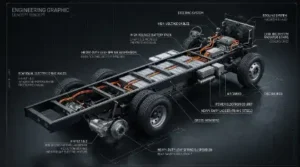 Transitioning a legendary midsize truck to electric power requires far more than dropping a battery into an existing engine bay. To ensure the electric variant survives the same punishment as its internal combustion predecessors, engineers retained the heavy-duty body-on-frame construction while integrating the high-voltage architecture safely within the ladder chassis, as detailed in Toyota Europe’s official newsroom announcement.
The core powertrain relies on a dual-motor permanent all-wheel-drive (AWD) layout:
- Battery Capacity: A 59.2 kWh lithium-ion battery mounted securely between the frame rails to lower the center of gravity.
- Dual Motor Output: A front electric eAxle producing 205 Nm of torque paired with a rear eAxle generating 268.6 Nm.
- Chassis Engineering: Retains standard 700mm wading depth capability with sealed high-voltage components and electric power steering.
By placing the battery within the frame, Toyota avoided compromising interior cab height or ground clearance. The instant torque delivery from the dual motors compensates for the lack of a traditional low-range transfer case, providing effortless low-speed control when climbing steep inclines or crawling through deep mud.
2. Performance, Payload, and Fleet Logistics
The primary hurdle facing any electric utility vehicle is balancing battery mass against practical working capacities. Heavy batteries can quickly degrade payload thresholds if total vehicle weight is not carefully managed. Toyota designed the initial battery-electric Hilux primarily around commercial fleets, municipal operations, and daily utility tasks where localized zero-emission operation provides massive cost savings. Detailed commercial specifications reported by The EV Report highlight how this setup optimizes daily operations.
While full-size electric trucks often rely on massive, heavy battery packs that drive up prices, the Hilux BEV utilizes a targeted pack size designed for efficiency and quick charging turnarounds.
| Capability Metric | Toyota Hilux BEV Specs | Practical Work Impact |
|---|---|---|
| Payload Capacity | 715 kg (~1,576 lbs) | Handles full equipment beds, tools, and site materials. |
| Towing Rating | 1,600 kg (~3,527 lbs) | Sufficient for work trailers, small machinery, and gear. |
| Driving Range | ~240 km (149 miles) WLTP | Optimized for urban routes, forestry, and closed job sites. |
For municipal operators and commercial fleets, the reduced mechanical complexity means fewer fluid changes, no diesel particulate filter (DPF) maintenance, and significantly lower operating costs over the vehicle’s lifespan.
3. Intelligent Off-Road Capability Without Differential Locks
Purists initially questioned how an electric truck could match the legendary off-road reputation established by mechanical diff locks and low-range gears. The answer lies in digital torque vectoring and millisecond-level traction management, as highlighted in YugaAuto’s drivetrain analysis.
Instead of relying on heavy mechanical differentials, the all-electric Toyota Hilux uses an updated Multi-Terrain Select (MTS) system. Because electric motors can adjust torque delivery instantly to individual wheels, the system senses wheel slip immediately and modulates power faster than a mechanical locker can engage.
Key off-road enhancements include:
- Precision Low-Speed Crawling: Smooth motor calibration prevents wheel spin on loose gravel, sand, or wet rock faces.
- Instant AWD Distribution: Independent front and rear motors adjust power distribution dynamically based on terrain incline and load shift.
- Silent Off-Road Navigation: Low ambient noise levels allow drivers to hear environmental obstacles, spotters, and changing surface conditions clearly.
4. Interior Technology and Safety Evolution
 Inside the cabin, the electrification of the Hilux brings a massive leap forward in comfort, ergonomics, and connectivity. Taking heavy inspiration from the latest Land Cruiser platforms, the interior blends tough, wipe-clean physical controls with modern digital displays. Additional cockpit specifications and safety enhancements are outlined on the Toyota Europe media hub.
A dual 12.3-inch screen setup serves as the primary command center, providing real-time power flow diagnostics, battery temperature readouts, and off-road pitch/roll angles. Driver assistance is elevated through the Toyota T-Mate safety suite, adding features like Proactive Driving Assist, Blind Spot Monitoring, and low-speed acceleration suppression designed specifically for busy job sites and crowded urban traffic.
5. Toyota’s Multi-Pathway Future: BEV, 48V Hybrid, and Hydrogen
Toyota’s strategy differs fundamentally from competitors aiming for exclusive, single-powertrain EV rollouts. As outlined in the Toyota Europe electrification strategy portal, the brand is deploying a multi-pathway framework across the midsize pickup category to cater to varying global infrastructure levels:
- Battery Electric (BEV): Targeted at urban commercial fleets, short-haul routes, and zero-emission zones requiring low maintenance and silent operation.
- 48V Mild-Hybrid Diesel: Combining the proven 2.8-liter turbodiesel engine with a compact 48V battery system to maximize fuel economy and maintain a 3,500 kg towing capacity for heavy long-distance haulers.
- Hydrogen Fuel Cell (FCEV): Planned for future production, utilizing hydrogen fuel cells to deliver rapid refueling times alongside zero tailpipe emissions for long-haul regional work.
Redefining the Global Midsize Pickup Segment
The introduction of the all-electric Toyota Hilux signals a major shift in the automotive landscape. By demonstrating that electric powertrains can be successfully integrated into a rugged, body-on-frame platform, Toyota is setting a new benchmark for midsize utility vehicles.
Electrification no longer means sacrificing utility or durability. As battery tech advances and alternative fuel networks grow, the electric Hilux proves that even the most legendary off-road workhorses can embrace a sustainable, high-tech future while staying true to their tough, dependable roots.