
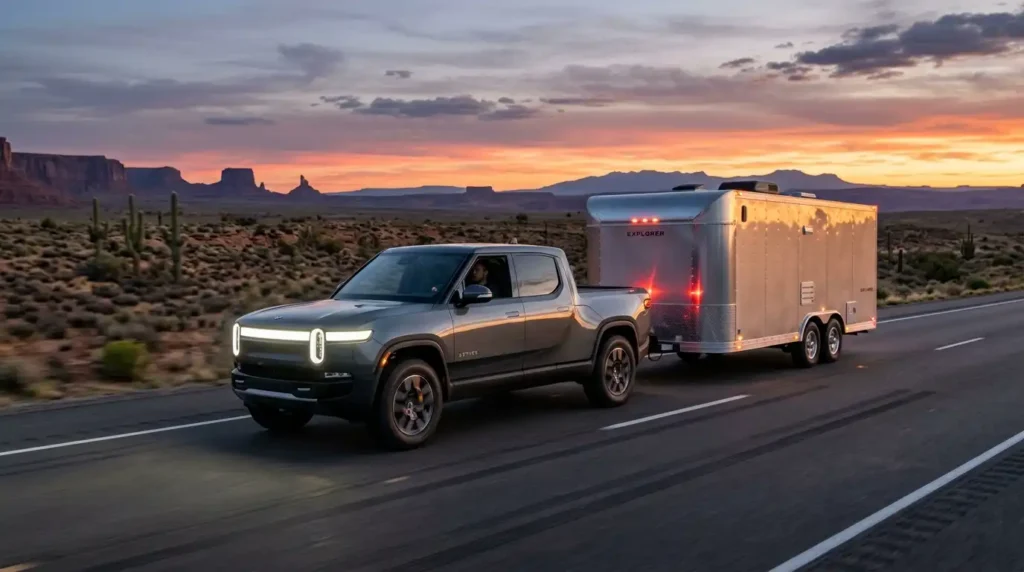
The Towing Bottleneck: Why Pure BEVs Struggle Under Heavy Loads

To understand why E-REVs are gaining momentum, it helps to examine how aerodynamic drag and weight impact pure electric trucks. Electric motors operate with high efficiency, but battery energy density remains significantly lower than liquid fuels by weight and volume.
When a full-size BEV truck hauls a multi-ton enclosed trailer, horse trailer, or construction rig, real-world Car and Driver test data on electric truck towing ranges shows that energy depletion can reduce driving distance by more than 50% under maximum load capacity.
- Dramatic Aerodynamic Drag & Energy Consumption: Towing a tall, boxy trailer at 65 to 70 mph increases aerodynamic drag exponentially. Real-world testing reveals that pure battery-electric trucks can lose up to 50% to 60% of their rated driving range when pulling near maximum capacity. A truck rated for 300 miles under normal conditions might yield only 110 to 130 miles between charges while towing.
- Charging Infrastructure Friction: Pulling into a public DC fast-charging station with a 25-foot trailer attached presents logistical challenges. Most public fast chargers are designed as pull-in stalls rather than pull-through lanes, requiring drivers to unhitch their trailers in crowded parking lots just to plug in. Compounded by long charge cycles under heavy energy depletion, long-distance towing becomes inefficient.
How E-REV Architecture Works
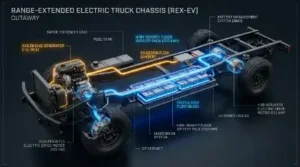
Range-Extended Electric Vehicles differ fundamentally from traditional parallel plug-in hybrids (PHEVs). In a conventional hybrid, both the internal combustion engine and the electric motor can physically drive the wheels through a mechanical transmission.
An E-REV uses a series hybrid architecture where the vehicle is driven purely by electric motors at all times:
- All-Electric Drivetrain: Electric drive modules (EDMs) mounted on the front and rear axles propel the wheels directly. Drivers experience instant maximum torque, smooth single-speed acceleration, and precise control when maneuvering trailers on steep inclines or loose terrain.
- Optimal Battery Sizing: Rather than packing an ultra-heavy, expensive 200+ kWh battery to compensate for towing loss, an E-REV utilizes a medium-sized battery pack (typically 70 kWh to 92 kWh). This keeps curb weight manageable and preserves payload capacity.
- Onboard Engine Generator: Beneath the hood sits a compact gas-powered engine coupled directly to an electrical generator. The engine has no mechanical link to the driveshaft or wheels. Instead, its sole purpose is to convert fuel into electricity, recharging the battery pack on the fly whenever energy levels drop.
Key Benefits of E-REVs for Heavy Towing & Fleet Operations
By decoupling the gas engine from the wheels and using it strictly as a dedicated power generator, E-REVs solve the primary operational limitations of pure BEVs while retaining key electric driving advantages.
1. Uncompromised Range Exceeding 600 Miles
When unhitched, an E-REV offers ample pure-electric range (often 100 to 145 miles) for daily local errands without consuming a drop of gasoline. When hitching up a heavy trailer for long-distance trips, the onboard generator kicks in automatically. Combined with a standard fuel tank, total driving range stretches to 600 to 700 miles, allowing drivers to refill at any gas station in minutes.
2. Full Torque Performance and Superior Towing Ratings
Because the wheels are driven entirely by electric motors, E-REVs do not sacrifice tow ratings. Flagship range-extended pickups can deliver over 660 horsepower and more than 600 lb-ft of instant torque, enabling maximum tow ratings of up to 14,000 pounds and payloads exceeding 2,600 pounds.
3. Mobile Power Station Capabilities for Job Sites
E-REV trucks double as high-capacity mobile generators. Integrated power outlets in the bed and cabin draw from the battery pack and onboard generator, producing kilowatts of exportable power to run heavy construction equipment, air compressors, or welding gear at remote job sites without carrying separate standalone generators.
4. Reduced Total Cost of Ownership (TCO)
For fleet operators, E-REVs bridge the operational gap during the transition to zero-emission technology. Fleet owners can complete daily short trips on low-cost grid electricity while retaining the flexibility to send vehicles on long-distance, heavy-towing assignments without buying specialized diesel tow rigs or worrying about regional charging station gaps.
The Future of Working Trucks
While pure BEVs remain an ideal choice for urban delivery vans, passenger sedans, and light-duty commuter pickups, heavy towing demands continuous, high-density energy delivery. By combining zero-emission local driving with the quick-refueling versatility of liquid fuels, Range-Extended Electric Vehicles (E-REVs) establish a practical path forward for the American pickup truck market.